Avian Cognition: Crows Match Primate Logic with Double Speed
New research reveals that carrion crows employ the same decision-making mathematics as monkeys but process visual evidence twice as quickly.
By Chioma Brooks ·
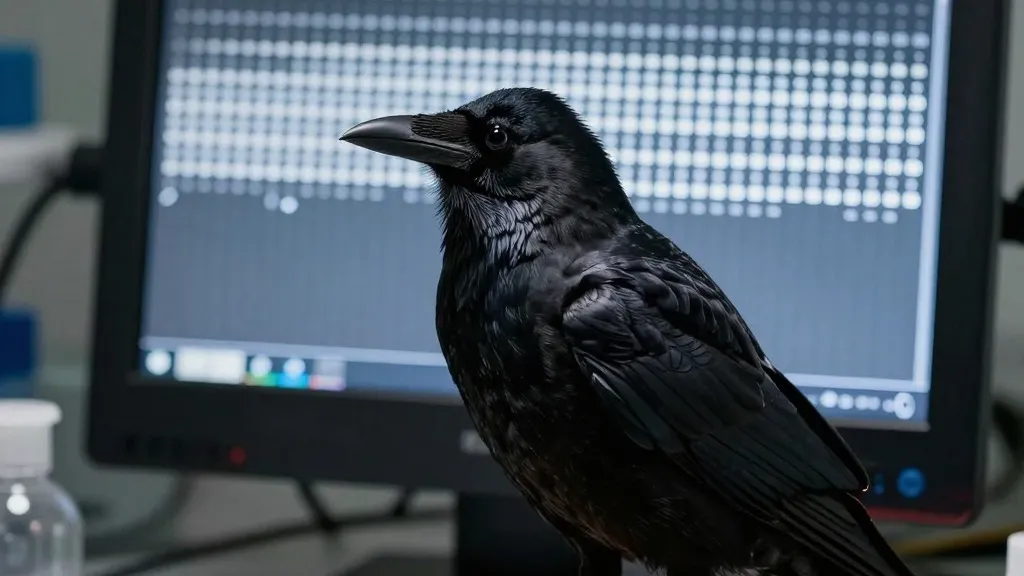
Carrion crows are making a significant mark in the field of comparative neuroscience. New data released this week shows that these birds utilize the same underlying mathematical framework for decision-making as primates. The striking difference lies in speed, with the crows completing the cognitive task at double the rate of their monkey counterparts.
The study relies on a standard benchmark in visual neuroscience known as the random-dot-motion task. In this setup, a cluster of flickering particles drifts weakly in a specific direction. Subjects must identify the direction of movement. In primate brains, neurons in the neocortex accumulate visual information over time. Their firing rates increase until they hit a specific threshold, triggering a final choice.
This mechanism has long been a mystery in avian neurobiology because birds lack a neocortex. Andreas Nieder, a neurobiologist at the University of Tübingen, identified this structural gap as the central puzzle. He noted that the primary question was how a differently organized avian brain could encode decisions.
To address this, Nieder and colleague Philipp Schmidbauer presented the task to two hand-raised carrion crows. The birds faced a touch-sensitive monitor displaying white dots against a black background. A portion of the dots moved cohesively in one of four directions. The crows indicated their choice by pecking a target beside the display, earning a mealworm for each correct answer.
The researchers maintained strict parity with existing monkey experiments to ensure valid comparisons. Nieder emphasized that they intentionally used the exact same task parameters. The sole procedural difference was the method of response. Monkeys indicated their decisions through eye movements, while the crows used pecks.
Difficulty levels were adjusted by varying the percentage of dots moving coherently. The easiest condition involved 81 percent of dots moving together, a simple visual cue. The hardest condition featured only 3 percent of coherent movement, making the signal barely distinct from random noise. A zero percent condition was also included to test for guessing behavior.
The results demonstrate that crows solve the task using the same logical process as primates, despite their distinct brain architecture. More notably, they achieve this with significantly greater speed. This finding confirms that a brain without a neocortex can generate complex decisions through a comparable computational pathway.