
CHAPEA Crew Completes 378-Day Mars Habitat Simulation in Houston
NASA's analog astronauts finished a year-long isolation test in a 1,700-square-foot enclosure, providing data on the 23-minute communication delays and resource constraints expected on actual Mars missions.
By Abigail Brooks ·
A one-way transmission from Earth to Mars can take up to 23 minutes, a delay that complicates simple digital exchanges. Ross Elder, an Air Force test pilot, notes that adding a single emoji to a message creates a four-megabyte file. That addition adds an extra four minutes to the transmission time. Elder served as commander for the Crew Health and Performance Exploration Analog, or CHAPEA, a program that concluded on Oct. 31, 2026.
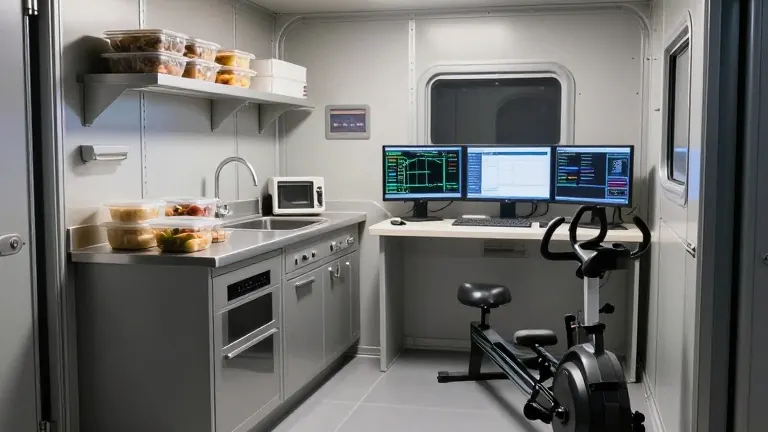
NASA’s CHAPEA mission required four crew members to live in a 1,700-square-foot prototype habitat at the Johnson Space Center in Houston. The enclosure operated from Oct. 19, 2025, to Oct. 31, 2026. The facility included four private sleeping quarters, two bathrooms, a science area, an exercise corner, a living room, and a galley kitchen. The team endured this isolation for 378 days to simulate the duration of a short Mars journey.
The simulation mirrored the workload of a future six-month outbound flight, a brief surface stay, and a six-month return. The crew performed mental and physical tests, studied water recycling, analyzed microbial DNA, and researched combustion. They also maintained crops in an indoor nursery. The team conducted simulated Mars walks in red soil areas and used virtual reality headsets on treadmills for longer excursions.
Sara Whiting, the CHAPEA project scientist, states that the crew generated data on exercise performance, cognitive load, and physiological measures. The team collected blood work and other biomedical points. Controllers introduced simulated equipment failures, known as injects, to test the crew’s response to breakdowns. Whiting notes that some alerts were simulated while others were real system issues.
The crew members included Elder, U.S. Space Force officer Ellen Ellis, aerospace technical director James Spicer, and electrical engineer Matthew Montgomery. The group attended a leadership program at the National Outdoor Leadership School to build interpersonal skills before entering the habitat. They managed their daily schedules with experiments, maintenance, and simulated emergencies.
Daily life included hot showers, a luxury not available on the International Space Station, though the crew limited usage to conserve water. They consumed thermostabilized rations similar to military meals, supplemented by fresh vegetables they grew. Elder lists tomatoes, peppers, leafy greens, mint, and basil among the crops they harvested. The crew also maintained a large collection of movies for entertainment.
Ellis served as the medical officer, trained to use medical equipment and make basic diagnoses. The mission plan allowed for the removal of a sick crew member if necessary, depending on the severity and contagion risk. Elder emphasizes that the primary goal is to do no harm while managing on-the-fly dangers.
All four CHAPEA crew members are applying to NASA’s new astronaut candidate program. The application period runs from Nov. 7 to Dec. 3, with winners announced next fall. Elder says the crew has joked that the selection process is easy because they are already ready for the trip.
More Business · Consumer Watch · Report a business · Got a Story?