Iran Unveils New Missile Launcher Amid Tanker Attacks in Strait of Hormuz
Iran unveils a new liquid-fuel missile launcher while striking three tankers in the Strait of Hormuz, as diplomatic talks continue and airstrikes persist in Gaza.
By Priya Marino ·
Iran has showcased a new missile launcher at an underground facility, signaling its continued capacity to strike as the conflict with the United States and Israel persists. The unveiling took place on Saturday, with state television broadcasting footage from the hidden site.
The Revolutionary Guard, a paramilitary force, presented the new launcher, which officials said is capable of firing two liquid-fueled missiles simultaneously. This system appears to be an advancement over previous dual launchers that utilized solid-fuel missiles. Liquid fuel is considered more efficient and allows operators to adjust the speed and trajectory of the missiles, offering greater tactical flexibility.
The specific location of the missile site was not disclosed. The broadcast served to highlight Iran's missile capabilities and to counter recent statements from Washington suggesting that the U.S. has significantly damaged Iran's missile program. These developments come amid growing fears that the war could intensify further.
Brig. Gen. Seyyed Majid Mousavi, commander of the Guard’s Aerospace Force, addressed the audience during the event. He stated that Iran’s capabilities have expanded significantly and that the country has integrated surprises and highly effective assets into its combat structure.
Diplomatic efforts are also ongoing. Iranian Deputy Foreign Minister Kazem Gharibabadi noted on Saturday that Tehran remains in contact with mediators from Qatar. Qatari officials visited Iran on Friday to explore whether another opportunity could be given to diplomacy to resolve the crisis.
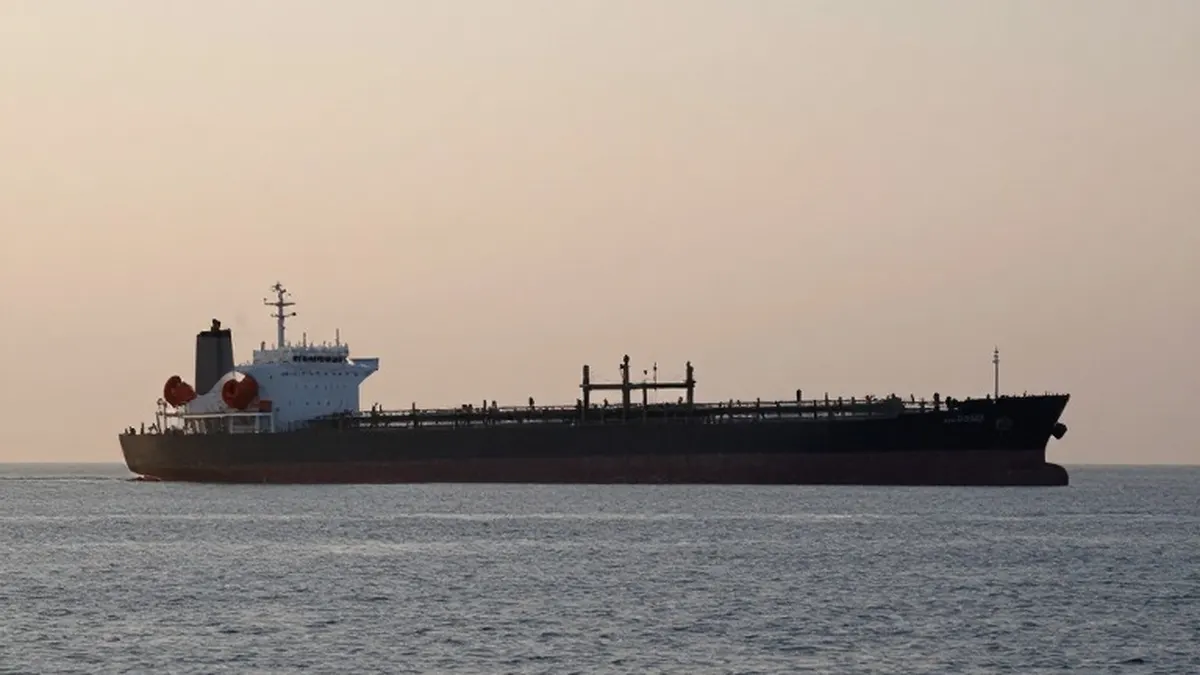
In the Strait of Hormuz, at least three oil tankers were attacked on Saturday. These incidents appear to be the latest in a series of Iranian strikes on shipping through this strategic chokepoint. The United Kingdom Maritime Trade Operations Center reported that two tankers were struck separately by projectiles early in the day while exiting the Persian Gulf.
According to the U.K. maritime security center, one tanker was hit in the stern and the other in the engine room. There were no reports of casualties from these two incidents. Iranian forces had not immediately commented on the center's report at the time of publication.
Separately, the Iranian navy announced that a tanker hit a naval mine east of the strait before noon and subsequently caught fire. State media reported that the military conducted its most intense and varied operations yet in the strait overnight. These operations aimed to stop vessels and foil U.S. military efforts to escort shipping through the narrows.
The campaign against shipping is designed to raise global energy prices, thereby pressuring the United States, which has imposed a blockade on Iranian ports. The attacks underscore the economic dimensions of the ongoing conflict and the strategic importance of the waterway.
In the Gaza Strip, an Israeli airstrike hit a truck carrying food in the Tel al-Hawa district of Gaza City on Saturday. Mohamed Abu Selmiya, the director of Shifa Hospital, confirmed that three men in the truck were killed. Videos circulating online showed the pickup truck reduced to twisted metal with boxes of cooked rice torn open in the back. It was not immediately known if the food was connected to a specific aid organization, though most of Gaza's population relies on such distributions.
The Israeli military stated that it had targeted Islamic Jihad militants traveling in a vehicle used for logistical supplies. The military noted that the vehicle was not visibly marked as belonging to a humanitarian organization. One of the men had been fired from an aid organization after Israel's military notified them of his militant role. The men were targeted due to recent attacks they had advanced against Israeli forces and civilians.
Despite a ceasefire deal with Hamas that came into effect in October 2025, Israel has continued near-daily airstrikes. The Gaza Health Ministry, part of the Hamas-run government, reports that more than 1,650 people have been killed since the ceasefire. The ministry, which is considered reliable by U.N. agencies, notes that women and children make up about half of the dead, though it does not distinguish between civilians and militants in its total count.
More News · National news · Report a business · Got a Story?