Moscow Airports Lose Up to Nine Hours Daily to Drone Threats
Insurers and airlines face rising costs as daily airspace closures force a rethink of risk premiums for flights to Russia.
By Chioma Brooks ·
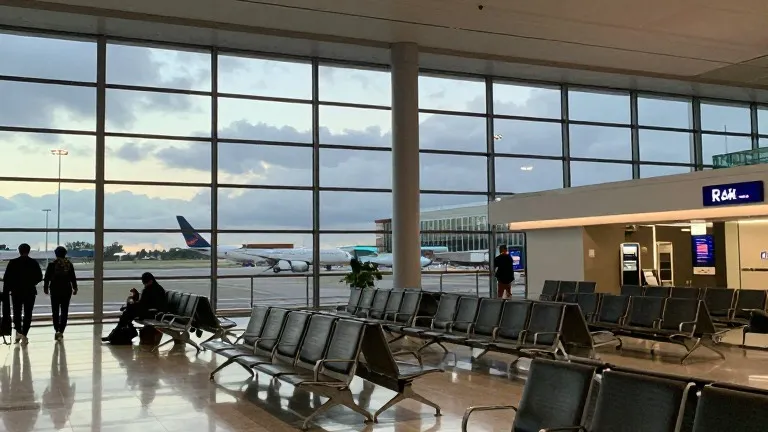
Moscow's four major airports have suspended operations for up to nine hours on some days this month, according to data from the independent outlet Agentstvo. The closures at Domodedovo, Sheremetyevo, Zhukovsky, and Vnukovo have become near-daily occurrences in October, creating a major bottleneck for regional air traffic.
The disruption is driven by a safety protocol known as the "carpet" rule, administered by the Russian aviation authority Rosaviatsiya. This procedure mandates an immediate airspace shutdown whenever unidentified objects appear or aircraft violate borders. Oleksandr Laneckij, chief executive of Friendly Avia Support, noted that every drone presents a military threat under this system. He compared the current situation to the disruption caused by Yemen's Houthis in Saudi airspace, adding that Ukraine's military capabilities far exceed those of the Houthis.
Production capacity in Ukraine is high enough to sustain this pressure. Military analyst Jan Matvejev stated that Ukraine's arms industry can produce hundreds of combat-ready long-range drones daily. These devices do not need warheads to trigger the protocol; their mere presence in the sky is sufficient to ground flights. Matvejev argued that Russian air defenses are struggling to keep up, noting that if the drones were easily shootable, Russia would have deployed more troops to the task.
The financial implications for the aviation market are becoming clearer. Laneckij identified three key factors determining whether foreign carriers will continue serving Russia: the military threat level, passenger demand, and insurance costs. If insurers classify the risk as severe, they will raise premiums, which will inevitably drive up ticket prices. Competition in the Russian aviation market has already contracted as many airlines have exited the sector, increasing reliance on the remaining foreign carriers.
Safety risks remain a central concern for operators. Matvejev warned that while shooting down low-flying drones with machine guns poses a low risk to airliners, the use of missiles is more dangerous. Defects in mass-produced missiles could send them toward nearby commercial aircraft. He referenced the 2024 crash of an Azerbaijan Airlines flight, where 38 people died after a Russian air-defense missile hit the plane during a drone counter-operation. Matvejev said little has changed in the Russian protocol since that incident.
The trend extends beyond Moscow. Ukrainian forces attacked Pskov airport in the summer of 2023, and drone debris landed at Sochi airport earlier this month. In September, President Volodymyr Zelenskyy confirmed that Kyiv's airport and Boryspil were struck by Russian forces. Zelenskyy had previously declared that Russian airspace would become completely unsafe, a warning sent to the International Civil Aviation Organization in early September.
More Business · World news · Consumer Watch · Report a business · Got a Story?