NASA Commits Three Rockets to 14 Day Lander Test
A complex orbital campaign involving SLS, Starship, and New Glenn aims to resolve critical readiness gaps before the 2028 lunar landing.
By Chioma Brooks ·
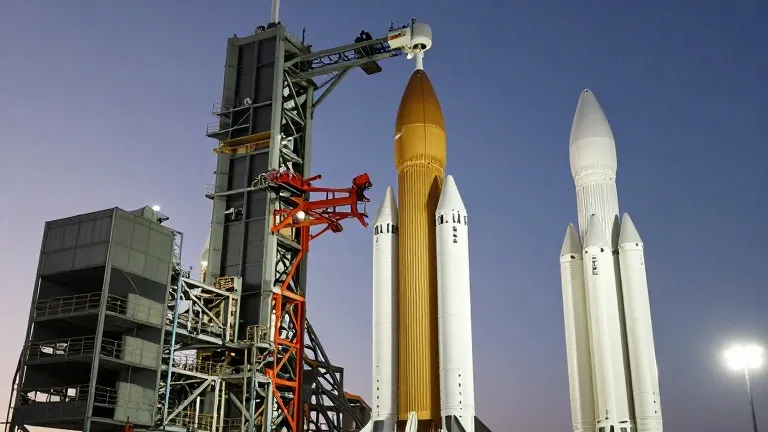
NASA detailed a high-stakes orbital test on Oct. 23 that requires three separate rocket launches to validate moon landers before astronauts attempt a surface touchdown. The agency presented the operational plan during a two-hour press conference at Kennedy Space Center in Florida. The mission is designed to resolve technical uncertainties that could delay the planned 2028 landing, the first crewed lunar mission since Apollo 17 in 1972.
The campaign begins with Blue Origin's New Glenn rocket, which will deliver the Blue Moon lander to low Earth orbit. NASA's Space Launch System follows, carrying four astronauts: Randy Bresnik, Andre Douglas, and Frank Rubio from NASA, and Luca Parmitano from the European Space Agency. SpaceX's Starship launches last, bringing a docking adapter to the assembly. Artemis program manager Jeremy Parsons described the sequence as likely the most complicated launch campaign ever undertaken.
The crew will spend the first two days inspecting Orion systems. On Flight Day 3, they will dock with Blue Moon at an altitude of 273 miles. The astronauts will enter the lander to test environmental controls, life support, and emergency protocols for two days. Around Flight Day 6, Starship launches with a 171-foot upper stage. It meets Orion on Flight Day 8 at 237 miles for a two-hour encounter where the crew remains inside the capsule to collect data on docking forces.
Following the Starship undocking, the mission continues for six to nine days before a parachute-assisted ocean splashdown. The nominal duration is 14 days, though it could extend to 17. The crew will conduct health assessments, science experiments, and evaluate survival suits, a task missed during the April Artemis II flyby. NASA Administrator Jared Isaacman noted that the agency is preserving options for both lander partners to ensure the best chance of readiness for the 2028 south pole mission.
Isaacman stated in a statement that NASA has no intention of surrendering a viable path to the surface before data and schedules compel a decision. Parsons confirmed that both providers are planning lunar landing missions for 2028, though the operational profiles differ significantly. With Blue Origin, Orion meets the lander in lunar orbit. With SpaceX, Starship will likely dock in Earth orbit and propel the capsule toward the moon.
The launch date remains uncertain. NASA targets summer 2027, but Isaacman told employees in a memo last month that the mission is approximately 90 days behind schedule. Parsons identified the lunar lander supply chain as a major challenge. Despite the delays, Isaacman expressed confidence in the team's ability to recover the timeline, saying the agency is moving with real speed and purpose right now.