Ohio State Ice Core Scientist Dies
Lonnie Thompson, who drilled deep into mountain glaciers to reveal Earth's climate history, died at age 78.
By Priya Marino ·
Lonnie Thompson, a professor at Ohio State University who spent five decades studying ice cores, died at the age of 78 on Nov. 3. The Byrd Polar and Climate Research Center announced the death, noting that he had been suffering from a brief illness.
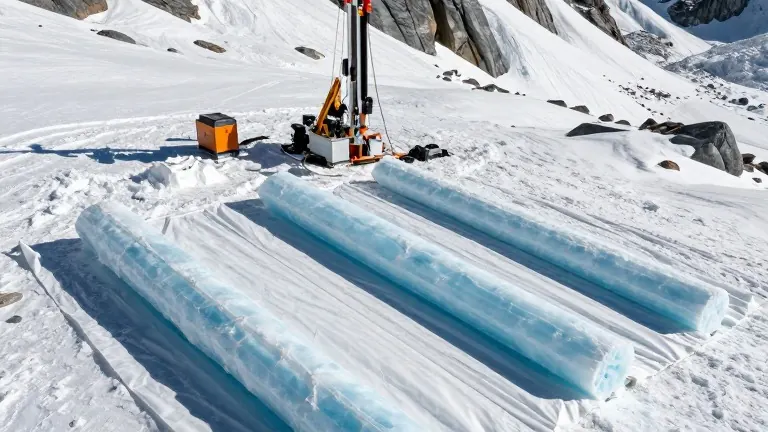
Thompson’s career was defined by his work in paleoclimatology, the study of past climates. While previous research focused on polar ice, Thompson led expeditions to the Andes, Himalayas, and Mount Kilimanjaro. He and his wife, Ellen Mosley-Thompson, drilled long cylinders of ice from these non-polar glaciers. These cores trapped air bubbles that preserved atmospheric conditions from thousands of years ago, providing a detailed record of Earth’s warming.
His work generated substantial data. According to his faculty profile, Thompson published 245 peer-reviewed papers, led 63 field programs, and secured 76 research grants. His observations of retreating glaciers offered concrete evidence of rising global temperatures. He received major honors including the National Medal of Science, the Tyler Prize for Environmental Achievement, and the Dan David Prize. He was also elected to the National Academy of Sciences.
Colleagues remembered him for his humility and communication skills. Ian Howat, director of the School of Earth Sciences, recalled a family cookout where his grandmother-in-law spoke with Thompson and Mosley-Thompson for two hours. She praised them as "salt of the Earth" without knowing their status. Howat later told her they were members of the National Academy of Sciences. She was "floored" by their accessibility.
"I think he was able to pierce the political bubbles," Howat said. "People from all backgrounds would listen to him. There was just something about him that he could communicate with people, make them feel respected even if he disagreed with you."
Thompson began his scientific journey in West Virginia, where he maintained a weather station in his family’s barn. He earned a master’s degree from Ohio State in 1973 and a doctorate in 1976. He began collecting mountain ice cores when he was 20, a feat Howat called remarkable because many told him it was impossible.
The 2023 film "Canary" documented his work studying glaciers. Thompson and Mosley-Thompson built a research group that trained undergraduates, graduate students, and postdoctoral researchers. Howat noted that new faculty will continue to use the ice core records, but Thompson was the one who collected them.
"Nobody can replace Lonnie, it’s impossible," Howat said.