
Starship Flight 15: Booster Splashdown After 22-Hour Mission
SpaceX's Super Heavy booster missed its target catch due to a technical issue, while the upper stage continues its orbit to attempt a historic pad return.
By Priya Marino ·
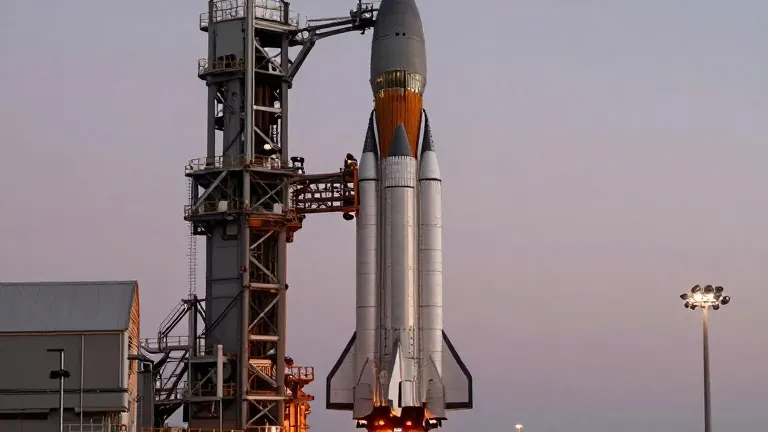
SpaceX launched the 236-foot-tall Super Heavy booster on Friday, carrying a payload of 8 million pounds of liquid oxygen and methane fuel. The vehicle, powered by 33 Raptor engines, lifted off from Starbase in Texas at 5:47 p.m. EST. This was the 15th test flight of the Starship program, designed to prove full reusability for an orbital-class rocket.
The booster successfully propelled the Starship upper stage out of the lower atmosphere. It separated from the main vehicle approximately two minutes and 20 seconds after liftoff. The first stage then flipped around to reverse course and head back to the launch site. However, flight controllers ordered a diversion to a Gulf Coast splashdown about six minutes after liftoff due to a technical problem.
Long-range cameras recorded the booster descending into the water, where it was surrounded by steam before residual propellants ignited. The company had previously managed to catch a Super Heavy booster during three earlier test flights. Those attempts used mechanical arms on the launch gantry to secure the rocket as it descended tail first. A splashdown remains a planned contingency if a safe capture is not possible.
The 171-foot-tall Starship upper stage continued its ascent using six of its own Raptor engines. It followed a sub-orbital trajectory to ensure a safe ocean splashdown while allowing time for health assessments. After an 18-minute coast, a single Raptor engine reignited for a 10-second burn to push the craft into its planned orbit. The first of 26 version 3 Starlink internet satellites is scheduled to deploy eight and a half minutes after that burn.
SpaceX plans to attempt its first launch pad catch of a Starship upper stage on Saturday. This maneuver would mark the first time the vehicle returns to the same pad for refurbishment and relaunch. Controllers will monitor the spacecraft throughout the flight to ensure it can be safely de-orbited if issues arise.
A final return check is expected one hour before the reentry sequence begins. A single Raptor is scheduled to fire at 3:21 p.m. Saturday to lower the orbit into the atmosphere. This will initiate a 56-minute belly-first reentry back to the Texas Gulf Coast. The vehicle will use four control flaps to maintain a precise trajectory during descent.
As Starship approaches Starbase from the west, it will maneuver around the Rio Grande Valley. The path passes north of South Padre Island and out over the Gulf of Mexico. The spacecraft will execute a final turn south toward the launch pad. Three Raptors will fire to flip the vehicle upright before the mechanical arms engage.
Once the vehicle is upright, one Raptor will shut down as it descends between the gantry arms. A single engine will slow the rocket to a near stop before the arms secure it. SpaceX describes the development of a fully reusable rocket as the holy grail of rocketry, aiming for a flight cadence similar to commercial aviation.
NASA relies on a Starship variant to carry Artemis astronauts to the Moon in 2028. The agency is currently evaluating the timeline and has stated it is open to using Blue Origin's Blue Moon Mark 2 lander if that vehicle becomes ready first. The decision will depend on which spacecraft meets the necessary readiness standards.
SpaceX provided details on safety protocols for the reentry phase. Flight controllers have options to end the mission early by tumbling the Starship to break it up in the atmosphere. Another option involves a late reentry into the Gulf if systems or the tower encounter issues. These pre-cleared areas include regions near Hawaii and off the coast of Chile.
More Business · Consumer Watch · Report a business · Got a Story?