Shenzhen Summit: Why the Xi-Putin-Trump Meeting Is Not a New Yalta
Analysts argue that the upcoming trilateral meeting in Shenzhen is unlikely to reshape global order, citing deep strategic and economic divergences between the three powers.
By Abigail Brooks ·
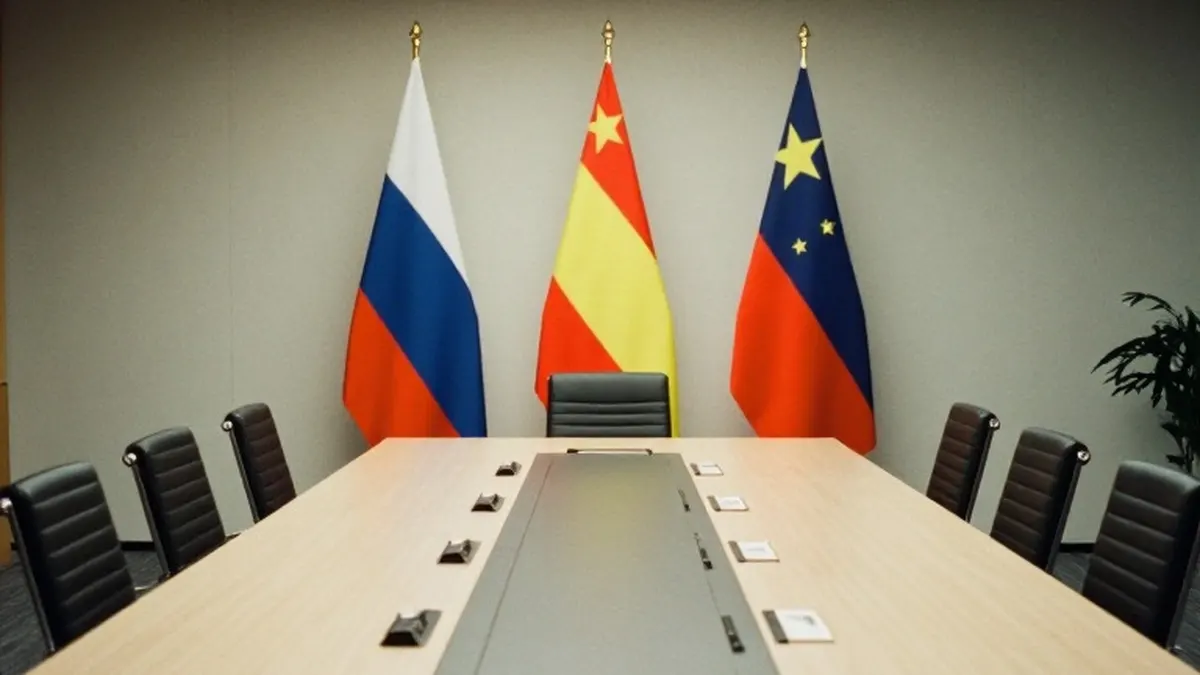
Leaders from China, the United States, and Russia are set to convene for a historic trilateral meeting in Shenzhen on November 19. The gathering will take place on the sidelines of the annual Asia-Pacific Economic Cooperation summit. This will be the first time the three nations have held formal trilateral talks, prompting some commentators to label the event as a landmark moment in international diplomacy.
In Moscow, many observers view the summit through the lens of history, comparing it to the 1945 Yalta Conference. That earlier meeting saw Britain, the Soviet Union, and the United States divide the world into spheres of influence. Russian President Vladimir Putin, who proposed this trilateral format during a call with US President Donald Trump in October, appears to share this worldview. However, experts suggest that the comparison to Yalta is largely wishful thinking rather than a realistic prediction of the outcome.
The fundamental difference from 1945 lies in the current geopolitical landscape. At Yalta, the three powers emerged as victors from a common enemy. Today, they find themselves on opposing sides of various conflicts and hold differing views on how the world should be governed. Although all three nations speak of a multipolar world and reject the language of hegemony, their definitions of this concept vary significantly. Moscow seeks to establish itself as a regional leader in Eurasia and a key pole in the new order. Washington aims to secure its status as the pre-eminent global power, while Beijing is focused on pulling the Global South away from US leadership.
These divergent aspirations are further highlighted by economic disparities. Russia has adopted a path that some describe as archaisation, opposing many manifestations of progress. In contrast, the United States and China are leading in technological innovation. They compete fiercely in sectors such as semiconductor production, mobile communications, space exploration, robotics, biotechnology, and artificial intelligence. In these critical areas, Russia has fallen behind by decades rather than years.
The disagreement over the summit's agenda reflects these deeper tensions. President Trump has expressed a preference for discussing nuclear disarmament, a topic that is less popular in China due to its smaller arsenal. Russia is also hesitant, as it relies on its nuclear capabilities to maintain its great-power status. Putin, meanwhile, wanted to focus on settling the Ukraine war without the presence of Ukrainian or European leaders. However, given his maximalist demands, it remains unclear what concrete achievements can be secured in talks with Trump and Chinese President Xi Jinping.
Recent consultations in Abu Dhabi and Moscow indicated that Putin seeks profound changes to the European order, which would violate international law. While a rollback of NATO might appeal to China, Putin’s insistence on violating the principle of sovereignty would likely be too much for Beijing. Consequently, Xi is expected to aim for a general declaration on cooperation rather than engaging in discussions that may hit a dead end.
For Xi, the summit represents a significant foreign policy triumph and an acknowledgment of China’s standing. He is hosting the leaders of two states that China once looked up to as superpowers. Since the late 1940s, China was highly dependent on the Soviet Union and replicated many of its policies. Later, after market reforms began in the late 1970s, Beijing became a key player in the US-led Western economic system, joining the World Trade Organization and capturing global markets.
It is symbolic that China welcomes these leaders at a time when it dominates global manufacturing and trade, boasts the fastest-growing economy of the three powers, and leads in the global technology race. The summit may lay the foundations for a new trilateral format. Trump may continue his unilateral policies, Putin may seek to revive Moscow’s superpower status, and Xi may use the format to institutionalize a G2+1 arrangement, anticipating that Russia’s role will diminish after the Ukraine war ends.
Despite the symbolic weight, little of substance is expected to come from the meetings. They are unlikely to be the venue where the world’s pressing issues are resolved. The three leaders belong to a generation of policymakers defined more by nostalgia and old prejudices than by powerful ideologies. In the coming years, as it did after the original Yalta, they may be replaced by a new generation leading the world toward a different future.