
54 Olive Ridley Hatchlings Released to Pacific After Aquarium Stay
The first documented nesting of the tropical species on the Southern California mainland concluded with a midnight beach release following a two-month incubation period.
By Abigail Brooks ·
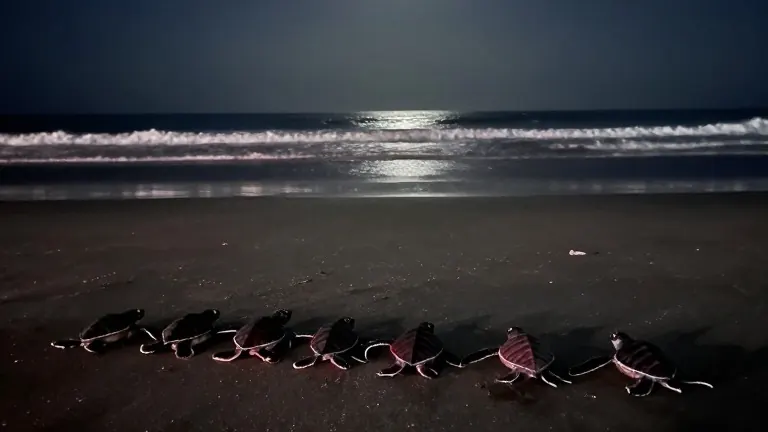
Fifty-four olive ridley sea turtles returned to the Pacific Ocean in the early morning hours of Saturday, ending a nearly two-month stay at the Long Beach Aquarium of the Pacific. The release marked the first confirmed nesting of the tropical species on the U.S. mainland West Coast. All 54 hatchlings reached the water, according to Dr. Lance Adams, the aquarium’s director of veterinary services.
The turtles hatched after 58 days of incubation at the Seal Beach site. Staff first observed cracks in the sand of the incubation container on Thursday. Active emergence began around 5 or 6 p.m. on Friday. The first hatchling appeared at 7:15 p.m. and remained at the surface for two hours before the rest emerged over the following two hours. Adams described the scene as a tangle of turtles.
In September, beachgoers discovered two nests of ping-pong-sized eggs. One nest contained 100 eggs in Huntington Beach. The other contained 104 eggs in Seal Beach. Officials moved the eggs to the aquarium on Sept. 25 after a forecast of hurricane swell and high tides threatened the nests. The turtles were kept at a consistent room temperature of 82 degrees, which was later raised to 85 degrees as recommended by NOAA and the U.S. Department of Fish and Wildlife.
The release was conducted in the dark to minimize light and human disturbance. Officials used red or infrared lighting to capture images from a distance. After the hatchlings entered the surf, staff swept the shoreline to ensure no weaker turtles washed back up. Any recovered turtles would have been returned to the aquarium to regain strength.
Wildlife officials noted that hatchlings undergo a frenzy period of continuous frantic swimming for 24 to 48 hours after reaching the ocean. This behavior is fueled by their remaining egg yolk sac. Jonathan Snyder of the U.S. Fish and Wildlife Service stated that warm water conditions were part of the story, but decades of conservation work also helped grow olive ridley populations.
Approximately 50 eggs from the Seal Beach nest remain unexamined. Staff will excavate the nest once they are confident no more turtles will emerge. The Huntington Beach eggs showed no signs of hatching as of Saturday. Olive ridley turtles typically reach maturity around 14 years of age. Current ocean temperatures in the 70s meet the ideal release threshold of above 68 degrees.
The species is recognized as the most abundant of the seven turtle species worldwide but remains endangered. Major Pacific nesting populations are found in Costa Rica, Mexico, Nicaragua, and Panama. People who observe baby sea turtles or strandings after the release should contact a lifeguard or the NOAA West Coast Stranding Hotline at 562-506-4315.