Hebrew University professor sets new rules for student use of AI
Claudia Goldman requires data science students to document their reasoning and verify AI outputs before submitting work.
By Priya Marino ·
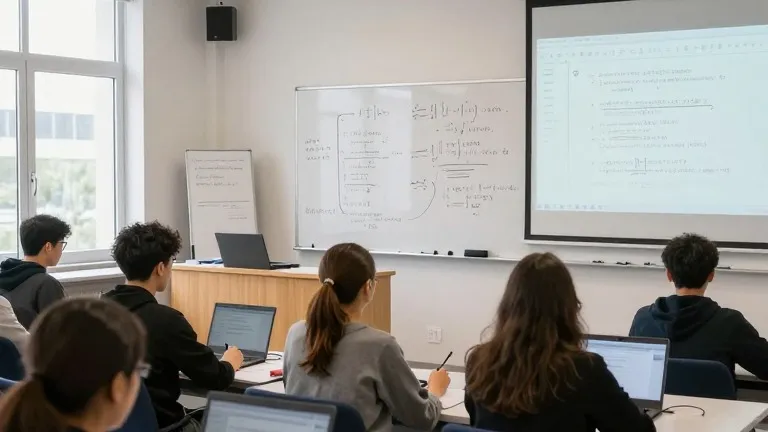
Prof. Claudia V. Goldman has established new protocols for artificial intelligence use in her data science classes at the Hebrew University Business School in Jerusalem. Since joining the faculty in July 2024, she has required students to demonstrate human effort in their assignments. She explains to students exactly when and why they can use AI tools. Every submission must credit the technology and explain the specific application. Goldman stated that fully AI-generated answers are not accepted. She told students she can detect AI in their writing.
Goldman encourages students to brainstorm with AI while maintaining a critical eye. She instructs them to check for bias in the information and verify that cited sources actually exist. This approach ensures that students use the technology as a tool rather than a writer. She evaluates understanding through a mix of classwork, presentations, and peer-led activities. These in-person assessments allow her to gauge comprehension directly. The curriculum also includes discussions on human responsibility and professional values.
Born in Argentina, Goldman moved to Israel in January 1984 at the age of 16. She graduated from Mae Boyer High School in Jerusalem in 1986. She served in the army before returning to the Hebrew University. She earned a BSc in computer science, mathematics, and electronics in 1991. She completed an MSc in computer science in 1993. She received a PhD in computer science in 1999 under the supervision of Prof. Jeff Rosenschein.
From 1999 to 2005, Goldman held research positions at Bar-Ilan University, the University of Massachusetts Amherst, and the University of Haifa. She then transitioned to the private sector. She worked as a team leader at Samsung Telecom Research in Herzliya for three years. She spent the next 15 years as a research scientist in General Motors' research and development organization, also located in Herzliya. Her career includes 24 patents and more than 50 academic papers.
During her time at General Motors, Goldman focused on learning agents for vehicle user experiences. Her work aimed to help drivers stay focused on the road while better understanding autonomous driving functions. She now applies this industry experience to her teaching. She believes in understanding the benefits AI brings to different roles. She emphasizes the critical skills needed to strengthen human capabilities in these contexts.
When asked about Bill Gates's proposal for a 'Human Reserved' concept, Goldman rejected a simple binary view of professions. She argued that the focus should be on the specific benefits AI offers in various settings. She highlighted the importance of critical skills that complement AI capabilities. The Business School currently offers courses in AI for Social Good, Responsible AI, and When AI Meets Humans and Society. The university also runs a Free Listener Program that allows senior citizens to audit courses.
Goldman grew up as the only child of Argentine-born parents. Her grandparents emigrated to Argentina before the Holocaust. She attended a Jewish school in Buenos Aires through seventh grade. She studied in Yiddish, Hebrew, and Spanish. She also attended public secondary school in the mornings. Her father had long wished to leave Argentina. In 1983, Goldman told him that Israel was the only place she could see herself growing up. The family made aliyah six months later.
She met her husband, Prof. Roy Shenhar, a full professor at the Hebrew University's Institute of Chemistry, on the Givat Ram campus. They first crossed paths on the stairs of the Ross Building. They ran into each other a third time in 1995. Following a Hebrew custom, he bought her ice cream because he had met her unexpectedly three times. They married in 1999.
Source: The Jerusalem Post