Iran moves forward with $25 billion Russian-built reactor
Tehran and Moscow are deepening their nuclear ties as inspectors struggle to access key Iranian sites.
By Priya Marino ·
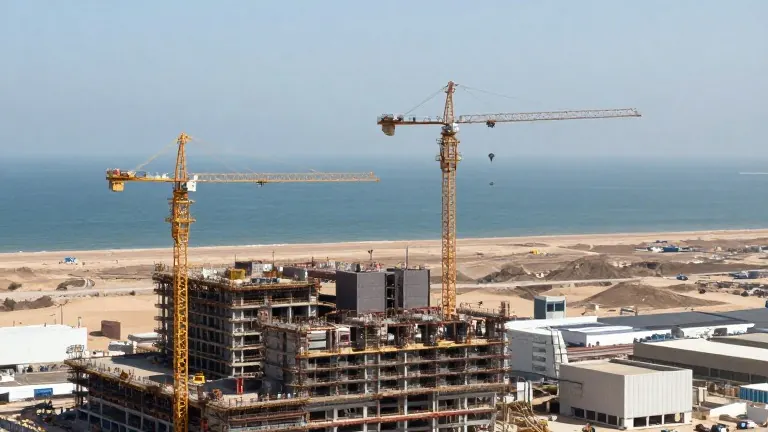
Russia’s state nuclear corporation Rosatom is returning personnel to Iran’s Bushehr plant while Tehran pushes ahead with a new reactor complex worth $25 billion. The move expands a partnership that has become central to both countries’ strategies as they face Western sanctions.
Rosatom reported on October 11 that 135 engineering and technical specialists were back on site at Bushehr. These workers had evacuated after the US-Iran war began in February. The plant is located on Iran’s southern coast. A contract to complete its first reactor was signed in 1995, but full commercial electricity generation did not start until 2013.
Construction continues on two additional units at Bushehr. Work on the second unit is more than 60 percent complete. Rosatom targets a start date of 2029 for that unit. A third unit is also under construction. The finished Bushehr complex will have a capacity of under 3 gigawatts.
The new Sirik plant will be built in Hormozgan Province, near the Strait of Hormuz. Iran’s state news agency IRNA reported the deal was signed in September 2025. The units at Sirik will have a combined capacity of about 5 gigawatts. This is nearly double the capacity of the finished Bushehr site. The agreement ties Iran’s civilian nuclear sector to Russian technology and fuel supplies for decades.
The legal basis for this expansion is the Comprehensive Strategic Partnership Treaty, which entered into force in October 2025. The practical roadmap is the intergovernmental Cooperation Plan for 2024-2026, approved in September 2024. For Russia, the deal offers commercial revenue and influence in the Middle East. For Iran, it provides access to nuclear expertise and fuel.
Analyst Nikita Smagin of the Carnegie Endowment for International Peace wrote in November 2025 that the balance in the relationship is shifting in Russia’s favor. He noted that Iran needs investment and Russia remains one of the few available sources. Researchers at Israel’s Institute for National Security Studies described Moscow’s policy as a calculated balancing strategy. They said Russia uses limited assistance and mediation offers to improve its relations with the United States.
International oversight of Iran’s nuclear activities has weakened during this expansion. In a report published on June 4, the International Atomic Energy Agency said it inspected Bushehr from June 1 to 3. The agency said it could not inspect other declared nuclear sites during that reporting period. These sites include four uranium enrichment facilities. The IAEA could not verify the status of nuclear material at those locations.
The agency also said it could not confirm whether Iran suspended uranium enrichment, reprocessing of spent fuel, and heavy-water activities. These processes can support the production of nuclear weapons. The report described a gap in international oversight during that specific period. The findings are not a real-time assessment of access today.
Both countries face extensive Western sanctions. Russia’s sanctions target energy, finance, trade, and defense sectors after its 2022 invasion of Ukraine. Iran has faced sanctions for decades over its nuclear program, ballistic missile program, and support for armed groups in the Middle East. These restrictions have pushed the two nations to develop alternative trade and technology channels.
Nonproliferation specialists are concerned about the potential for sensitive technologies to be diverted. Some analysts point to Iran’s accumulation of uranium enriched to 60 percent. This level is not weapons-grade, but it can be enriched further to around 90 percent. The US-based Arms Control Association stated in June 2025 that enrichment to 60 percent has no civil justification and puts Iran in a position to quickly produce enough material for a bomb.
Source: RFE/RL