Pennsylvania Turnpike tollbooths vanish as open-road system launches in January
Eighty-six years of physical barriers end next month, replaced by overhead gantries that scan drivers without requiring them to slow down.
By Priya Marino ·
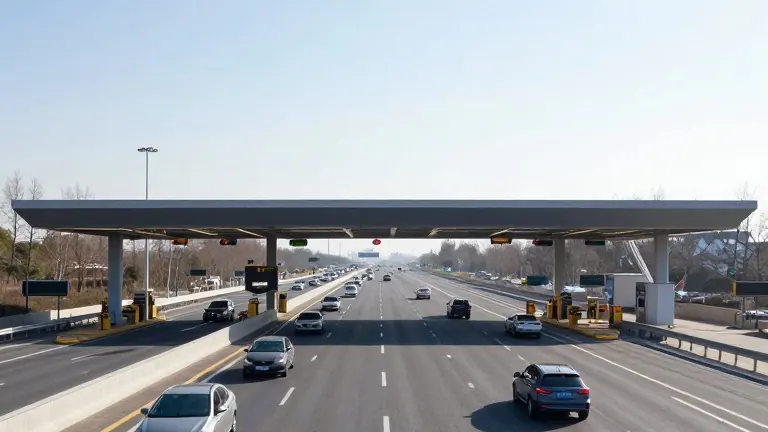
For nearly nine decades, the Pennsylvania Turnpike defined travel in the Commonwealth through its physical tollbooths. Those concrete structures, which have stood since the road opened in 1940, are about to disappear. The Turnpike Commission will replace them with an open-road tolling system that launches in Western Pennsylvania on Jan. 3.
The change ends the era of slowing down to pay. Instead of merging into specific lanes at interchanges, drivers will maintain their speed and stay in their current lanes. Overhead gantries positioned between interchanges will scan E-ZPass devices as vehicles pass underneath. The commission has been developing this technology since 2010.
Mark Compton, the commission’s CEO, said the system allows for a smoother flow of traffic. He noted that the physical tollbooths required drivers to brake and weave between lanes, creating hazards. Under the new system, those maneuvers are no longer necessary.
Compton pointed to data from Eastern Pennsylvania, where 19 gantries have been active since January 2025. He reported a decrease in rear-end and sideswipe crashes in that region. “A big part of what we’ve seen in the east is that there’s a lot less rear-end crashes (and) a lot less sideswipe crashes because you no longer have to weave between those interchange lanes,” Compton said.
On Jan. 3, 18 additional gantries will become operational. Eleven of these will be located in Western Pennsylvania, and seven will serve the central part of the state. This expansion completes the transition to frictionless charges across the network.
The cost structure for customers will change slightly. E-ZPass users will pay 7.5 cents per mile in 2027, plus a segment fee of $1.17. Crispin Havener, a turnpike spokesman, confirmed these figures. This represents a 3.5% increase over the current rate of 7.3 cents per mile and a $1.13 segment fee.
Havener explained that the price hike is tied to the turnpike’s obligation to fund statewide ground transportation under Act 44. It is not a direct cost of implementing open-road tolling. However, bills will list charges for each distance between gantries rather than a single total sum.
The infrastructure footprint will shrink considerably. The large office buildings that once housed toll collectors will be replaced by 630-square-foot maintenance huts. Shane Szalankiewicz, the Turnpike Construction Engineering Manager, described these structures as roughly the size of a studio apartment.
Inside these huts, servers store customer IP addresses and transmit data to headquarters in Harrisburg via fiber-optic cables. A backup generator ensures connectivity if commercial power fails. Workers only need to visit weekly to check fuel levels, according to Szalankiewicz.
Demolition of the old tollbooths in the central and western regions will begin shortly after the new system goes live. That work is scheduled to continue until the end of 2028. Compton said the smaller gantries require less pavement maintenance, offering a long-term financial benefit. The new layout also allows for more flexible entry points for nearby communities, such as the planned connector to Route 981 in Penn Township.