Septic and Farm Waste Cloud Michigan Waters
Three quarters of state streams fail fecal limits, prompting calls for stricter oversight, new farm rules, and increased sewer funding.
By Chioma Brooks ·
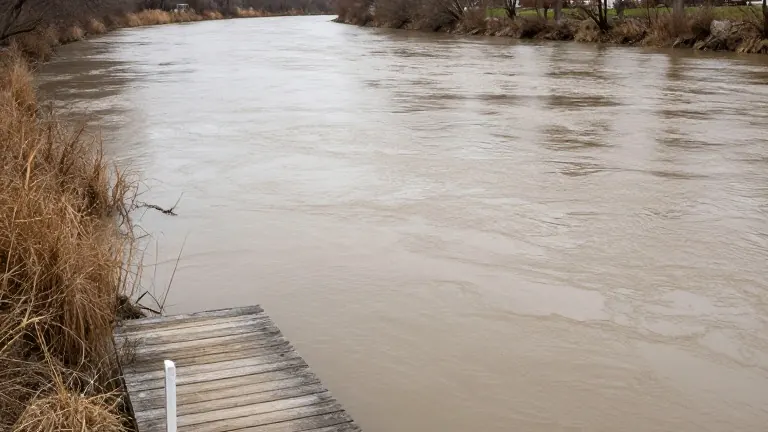
Fecal pollution now exceeds safety limits in 75% of Michigan rivers and streams. Experts argue that the state can reverse this trend through targeted regulation and funding, mirroring successful cleanups of the Rouge and Kalamazoo rivers in the mid-twentieth century.
The primary driver of the contamination is an estimated 330,000 failing septic systems. Michigan remains the only state without a uniform statewide sanitary code. Instead, the state relies on inconsistent local regulations that often lack enforcement. Water advocates are pushing for a uniform code that mandates periodic inspections. While the concept has bipartisan support, legislative efforts have stalled over cost concerns and inspection timing.
Liz Kirkwood, strategic partnership officer at Flow Water Advocates, said the next governor should champion the legislation. She stated, “Here you go. We’re the 50th state.”
State oversight of water quality is strained. The Michigan Department of Environment, Great Lakes and Energy employs more than 1,600 people. Only one employee is dedicated full-time to monitoring rivers and streams for E. coli. Staffing to enforce manure pollution rules at large livestock farms has remained largely unchanged for decades, even as the number of such farms has tripled. Currently, seven people work at least part-time on these compliance efforts.
Republican lawmakers have recently moved to reduce the department’s staffing and budget, arguing its regulatory approach is too heavy-handed. Environmental advocates counter that limited staffing hinders the state’s ability to investigate pollution and ensure industry compliance.
Agricultural runoff is the nation’s leading source of river pollution, according to the US Environmental Protection Agency. In Michigan, the state and federal governments rely largely on voluntary efforts to curb this pollution. Large livestock farms must obtain permits, but environmentalists and state regulators say the terms are too weak. Farm groups have resisted stronger rules, describing them as confusing and onerous.
Eric Dennis, a research associate at the Citizens Research Council, said Michigan should rethink its regulatory approach rather than tweaking a permit system that applies to only a subset of farmers. He said, “We need to find a better way to do this.”
Cities across the state are under orders to update combined sewers that overflow during rain events. Funding shortfalls have delayed these projects. The federal government reduced its financial contribution to water infrastructure, and the state did not fill the gap. Local governments have absorbed the costs while facing revenue declines from deindustrialization and population shifts to the suburbs.
The state currently allocates $200 million in non-federal dollars to water infrastructure annually. This amount is a fraction of the $5 billion spent on roads. Lawmakers are considering a bill that would impose a 25 cent-per-gallon royalty on bottled water companies to fund water initiatives.
Resident actions also affect water quality. Michigan has 2.4 million dogs, and experts say many owners do not pick up pet waste. Development that replaced wetlands with grassy lawns has created habitat for geese and ducks, increasing runoff into waterways. Rachel Cuschieri-Murray, executive director of the Eaton Conservation District, said education is a key part of the solution. Residents can help by picking up pet waste, planting native grasses near water, and fixing illicit sewer connections or malfunctioning septic systems.