Two Million Citizens, 252 Dead: The Stakes of Israel’s 2026 Vote
Palestinian citizens of Israel face a critical election Tuesday as their communities report the highest annual death toll in history.
By Abigail Brooks ·
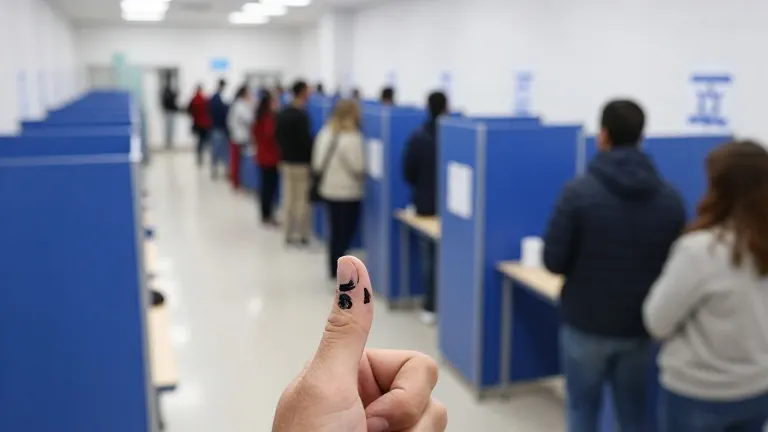
Palestinian citizens of Israel stand to cast decisive votes in Tuesday’s general election, a day that arrives against the backdrop of the deadliest year on record for their communities. With the nation’s political future hanging in the balance, the two million Palestinian citizens, roughly 20 percent of Israel’s 10 million residents, are positioned as a key factor in the formation of the next government. The election follows a year in which 252 members of the Palestinian minority were killed, a sharp increase from the 244 deaths recorded in 2023 and 116 in 2022.
The numbers reveal a stark disparity in safety and legal treatment. According to the Abraham Initiatives, an Israeli civil society organization, 50 percent of violent crime in the country affects Palestinians, despite their smaller population share. The group’s 2024 report notes that Israeli police solved fewer than 15 percent of killings in Palestinian communities, a clearance rate far below the 65 percent average for cases involving Jewish victims. Community representatives have accused the police of turning a blind eye to the illegal arms trade, while the Israeli government denies responsibility for the rising death toll.
This demographic traces its roots to the survivors of the Nakba, the 1948 war that led to the expulsion of 80 percent of the Palestinian population. Around 150,000 Palestinians remained within the borders of the newly established state, living under a military regime until 1966. Today, they reside primarily in the Galilee, the Triangle region, and the Naqab desert. Approximately 80 percent are Muslim, 10 percent Christian, and 10 percent Druze. Many identify as Palestinian citizens of Israel rather than Israeli Arabs, a term they often reject.
Legal frameworks continue to shape their daily lives. Adalah, a Haifa-based legal center, has identified more than 65 Israeli laws that explicitly or implicitly discriminate against Palestinians. These include the 1950 Absentees’ Property Law, which placed the assets of those who left or were expelled in 1948 under state control, and the 2018 Nation-State Law, which downgraded Arabic to a status of special significance. The 2011 admissions committee law further allows certain towns to reject residents based on their compatibility with a Zionist-Jewish character.
Political organization has been the primary tool for challenging these structures. The Joint List, formed in 2015 by Hadash, Balad, and Ta’al, won 15 seats in the 2020 election. Ra’am, a separate party, broke a long-standing taboo in 2021 by joining the governing coalition led by Naftali Bennett and Yair Lapid. That move helped end Benjamin Netanyahu’s 12-year tenure as prime minister. For the 2026 election, Hadash, Balad, and Ta’al have reunited under the Joint List banner, while Ra’am campaigns independently.
Projections indicate that these two alliances could win between 18 and 20 seats in the Knesset. This potential bloc size grants them considerable influence over coalition negotiations. The outcome will determine whether these parties hold the balance of power in a fragmented parliament, directly impacting the policy direction for the minority population. Voters like Asia Egbaria, a first-time voter, cite a desire to end treatment as a second-class citizen as their primary motivation for participating in the vote.