NASA plans 17-day orbital test flight for two lunar landers in 2027
The Artemis III mission will validate crewed docking procedures for SpaceX and Blue Origin hardware before a planned lunar landing in 2028.
By Abigail Brooks ·
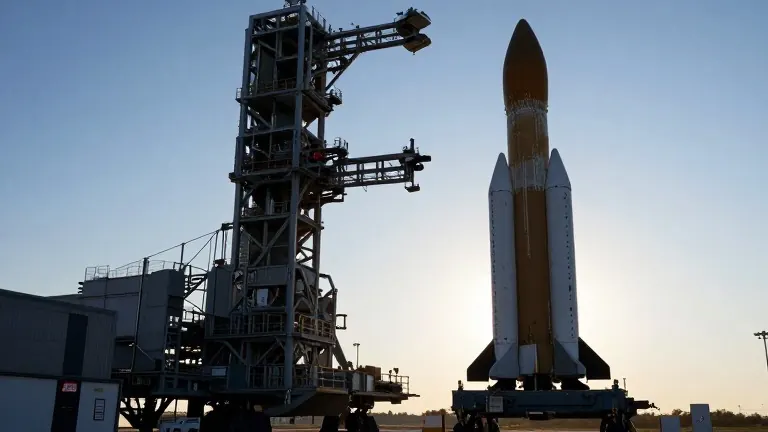
NASA intends to execute a complex 17-day orbital mission in the summer of 2027 to test two competing lunar landers.
The agency plans to launch an uncrewed Blue Origin New Glenn rocket carrying the Blue Moon lander from the Kennedy Space Center in Florida. Following that launch, NASA will fire its Space Launch System rocket to deliver four astronauts aboard the Orion spacecraft into orbit.
The crew will rendezvous with the Blue Moon, dock, and enter the vehicle to inspect its systems. They will then return to the Orion before docking with a second uncrewed SpaceX Starship lander. The astronauts will not enter the Starship because it lacks a life support system for this test phase. The entire sequence is designed to conclude with a splashdown after up to 17 days.
NASA Administrator Jared Isaacman, Associate Administrator Amit Kshatriya, and Artemis Program Manager Jeremy Parsons detailed these plans during a two-hour press conference at the Kennedy Space Center on Oct. 23. Isaacman stated that the agency must tackle difficult engineering challenges to return astronauts to the moon in 2028.
"In that remarkably short span of time, the ambitions of generations once confined to the pages of science fiction became humanity's greatest achievement, and for the first time in billions of years, life born on Earth would set foot on another world," Isaacman said. "Now, in this incredibly demanding and dangerous business of putting astronauts [back] on the moon, NASA must own the near impossible…That is how we give Artemis IV the greatest possible chance of safely and successfully returning Americans to the lunar surface in 2028."
The mission structure arises from physical limits in rocket technology. A single spacecraft capable of landing on the moon and reentering Earth's atmosphere would be too heavy. Therefore, the operation splits the workload between a lightweight lander and an orbiting mothership. This mirrors the Apollo program, where Grumman built the lunar module that landed crews on the moon between 1968 and 1972.
NASA awarded its first crewed lunar lander contract to SpaceX in 2021. The company's Starship is a 165-foot-tall cylinder that critics say resembles a silo rather than a traditional spacecraft. In 2023, NASA issued a second contract to Blue Origin to build a lower-profile lander similar to the Apollo module. Both companies will fly their vehicles during the 2027 mission, with performance data determining which system is selected for the crewed landing in 2028.
SpaceX has launched 14 Starships since 2023, achieving Earth orbit for the first time in September 2026. During the 2027 mission, the company will fly a prototype equipped only with a docking port to test the connection with Orion. Blue Origin's New Glenn rocket launched three times between January 2025 and April 2026. A major explosion on the launch pad in May 2026 damaged the first stage engines and partial pad infrastructure, creating a significant setback.
Parsons noted that over 100 NASA team members are engaged in supporting Blue Origin's return to flight. "Blue Origin's New Glenn team has amazed the world with their progress for return to flight after the incident in May," Parsons said. "We're working closely with them. We have over 100 NASA team [members] engaged throughout return to flight…and I have seen Blue Origin mobilize an absolute army working around the clock."
The Blue Moon lander will include a functioning crew compartment for the 2027 test. "They're going to open up the hatch. They're going to enter the lander. They're going to evaluate the environmental controls, the life support systems," Parsons said. "We'll confirm that the spacecraft can maintain the right atmospheric pressure, and we're also going to test emergency scenarios, dual vehicle control, and we're going to put our Mission Control teams through their paces."
A successful 2027 flight is a prerequisite for the 2028 Artemis IV landing. Even after the orbital test, NASA requires both competing spacecraft to complete uncrewed lunar landing and liftoff missions to certify them for crew. Isaacman expressed confidence that the agency can meet the 2028 target without slipping into 2029, despite a timeline that leaves a maximum of 18 months between the 2027 test and the 2028 landing. He acknowledged that the current pace is a closer race against China than previous missions required.
More Business · Consumer Watch · Report a business · Got a Story?