House Race: Democrats Chase Three Seats in 46 Toss-Up Districts
With all 435 seats up for grabs, the narrow margin of victory and new district maps in seven states define today's critical contest for congressional control.
By Abigail Brooks ·
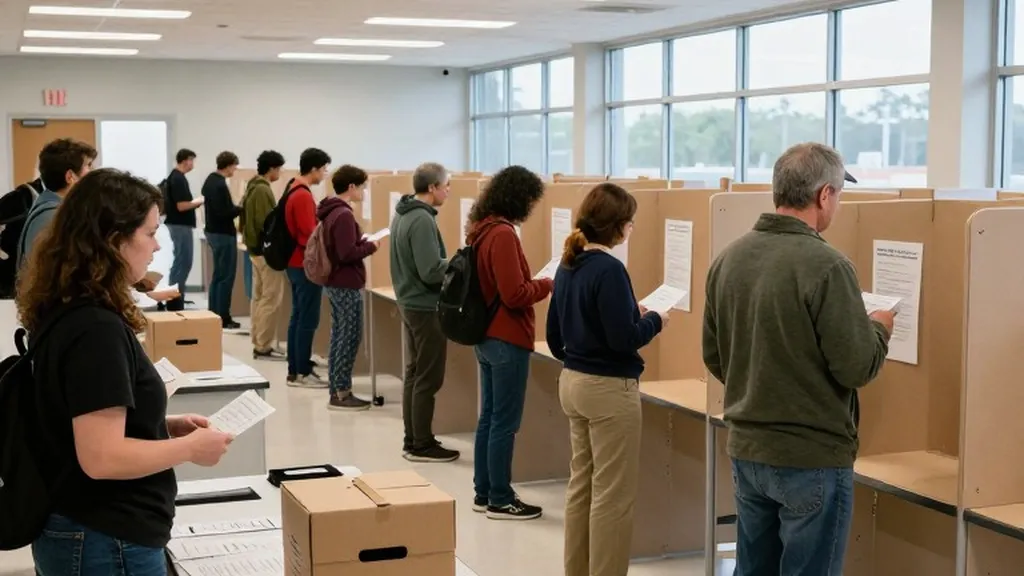
All 435 seats in the U.S. House of Representatives are up for election today, making this a complete reset of the lower chamber. According to Ballotpedia, the current division of power is razor thin, with Republicans holding 218 seats and Democrats holding 214. This configuration leaves one independent seat and several vacancies, creating a tight race where every vote counts. The Associated Press notes that the outcome will determine who controls the House for the final two years of President Donald Trump's second term. For Democrats, the path to a majority is precise but challenging. They need to achieve a net gain of three districts to take control of the chamber. Conversely, Republicans can afford to lose no more than two seats to retain their current majority. This three-seat margin makes the election particularly sensitive to small shifts in voter turnout and regional performance.
The battleground for this contest is concentrated in 46 districts identified by Ballotpedia as competitive. Of these, 25 are currently held by Democrats and 21 by Republicans. The composition of these races reflects the shifting political landscape following the 2024 presidential election. Ballotpedia reports that 21 districts held by Democrats voted for Trump in the last presidential cycle, while nine Republican-held districts voted for Kamala Harris. This overlap suggests that many of the tightest races are in areas where partisan loyalty is mixed or where voters may be reconsidering their choices. The stakes are high for both parties, as control of the House grants significant oversight powers and the ability to initiate impeachment proceedings, a possibility the Associated Press highlights if Democrats win either chamber.
A major complicating factor in today's vote is the implementation of new congressional maps in seven states. Mid-decade redistricting has altered the boundaries in California, Florida, Missouri, North Carolina, Tennessee, and Texas. Ohio also uses a new map for this cycle. These changes were often driven by Republican-led efforts to optimize district shapes for their party's advantage. However, the Associated Press notes that some of these newly drawn districts may not vote as expected, adding an element of uncertainty to the Republican strategy. Democrats argue that these maps represent an attempt to lock in power, while Republicans contend the lines reflect demographic changes. Voters in these states are casting ballots in districts that may look significantly different from those they voted in four years ago.
The cost of living and health care have emerged as central themes for Democratic voters heading into the polls. The Associated Press describes the election as a referendum on the administration's handling of the economy, with many voters expressing frustration over high prices. In a recent AP-NORC poll, 25% of U.S. adults approved of the president's handling of the economy, while about seven in ten said the country is heading in the wrong direction. James Moore, a 57-year-old librarian in Raleigh, North Carolina, told the AP that he is paying more for taxes, healthcare, and everything else. This sentiment is echoed in the Democratic campaign messaging, which focuses on immediate relief for households struggling with inflation and rising costs. The party is leveraging these economic anxieties to mobilize its base in the 46 battleground districts.
Republican strategists are emphasizing the importance of turnout to maintain their grip on the House. RNC Chairman Joe Gruters stated that everything depends on getting their voters to the polls. The party has a significant financial advantage in this cycle, with committees outraising and outspending their Democratic counterparts. According to an AP analysis of AdImpact data, 88.1% of Republican general election TV ad spending went to states and districts that Trump won in 2024. This includes more than $850 million spent in districts where he won by 10 points or more. Despite this spending advantage, the Associated Press notes that one or two seats could tip the balance in either chamber. The money edge is a tool, but the final outcome will depend on voter behavior in the tightest races.
The election also serves as a test for the administration's oversight powers. If Democrats gain control of the House, House Leader Hakeem Jeffries has outlined a 100-day agenda focused on the cost of living and oversight of the executive branch. The Associated Press notes that a strong Democratic performance would also boost the profiles of potential 2028 presidential candidates, including Gavin Newsom, JB Pritzker, and Pete Buttigieg. For Republicans, a loss of the House could complicate the path for Vice President JD Vance. The party has tried to beat the historical midterm pattern, where a president's party almost always loses seats, by leveraging redistricting and high-profile endorsements. President Trump held dozens of rallies in the lead-up to the election, including a final stop in Salina, Kansas, where he urged voters to pretend he was on the ballot.
Voter enthusiasm appears to be high, with more than 57 million people having already voted as of Monday, surpassing early vote totals from four years ago in many closely watched states. The U.S. Postal Service has added hours, staff, and special lines to ensure mail ballots are counted on time, a critical step in states like California and Colorado where mail voting is prevalent. A federal judge temporarily barred the administration from implementing a plan to prevent noncitizen voting, a move that critics said risked disenfranchising eligible voters. This legal backdrop adds a layer of complexity to the election administration, with the Justice Department threatening to prosecute local election officials in some cases. Voters are navigating these procedural hurdles while focusing on the substantive issues of the day.