Breaking: Strategists warn of AI reckoning after $2.5 trillion Nasdaq crash
Experts describe a capitulation event and rising political hurdles as the market enters correction territory following the midterm elections.
By Abigail Brooks ·
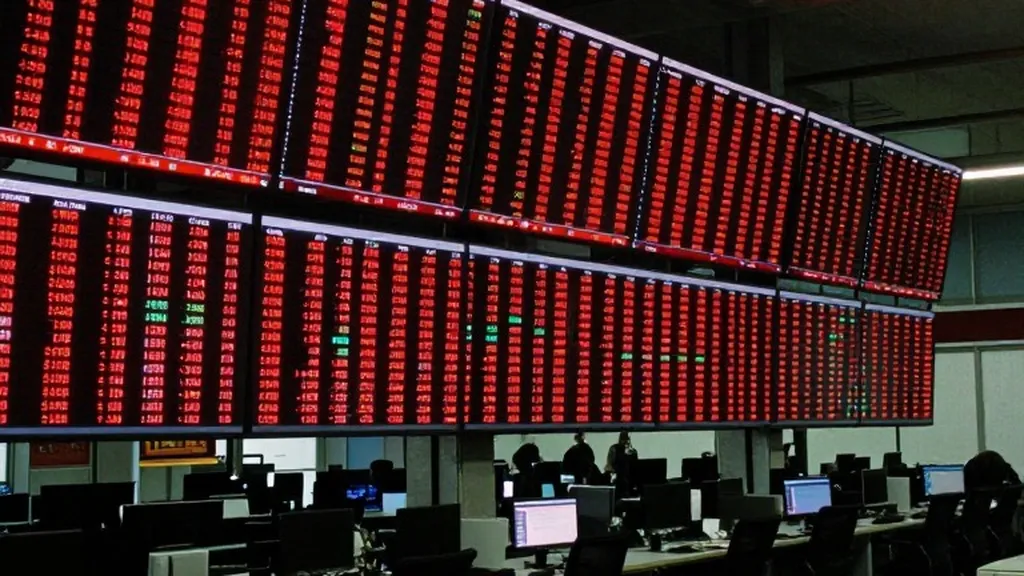
Wall Street strategists are describing today's market crash as a pivotal moment where the promise of artificial intelligence meets its tangible price. The Nasdaq Composite fell 5.5 percent on Thursday, marking its worst day in 18 months and closing more than 11 percent below its recent record. This drop places the index firmly in correction territory, a decline of at least 10 percent from a peak. An estimated $2.5 trillion in market value was wiped from the Nasdaq Composite in a single session. The selling pressure was not limited to technology stocks, as the S&P 500 fell 4.3 percent and the Dow Jones Industrial Average dropped more than 1,800 points, a loss of 3.4 percent.
Neil Wilson, an investor strategist at Saxo UK, characterized the event as a complete capitulation-level event playing out in tech stocks. He noted that the fear of a total momentum unwind is driven by Democrats pacing the frontier and potentially stopping data center buildouts. Wilson stated that while the market action looks totally overdone, the nature of selling everything in this market means investors need to look for stability first. This sentiment reflects the immediate shock felt by traders as the index slid into deeper negative territory before the closing bell.
Political dynamics in Washington are now viewed as a primary driver of the sell-off. Dan Ives, a tech analyst, stated that there is no way to sugarcoat the fact that Democrats taking control, especially over the Senate, will create major hurdles for AI and tech legislation in the Beltway over the next two years. He added that the midterm results are a clear sign that the pace of data center build-out will start to slow. This legislative friction adds a new layer of uncertainty for companies that have relied on rapid infrastructure expansion to support their growth narratives.
Ted Parkhill, founder and chief executive of Incline Investment Management, offered a different perspective on the valuation of these assets. He observed that the market is moving from the promise of AI to the price of AI. Parkhill acknowledged that AI is going to be transformative for the world in the long run, but he argued that does not mean every AI-related stock is currently priced appropriately. He warned that there is going to be a lot of turmoil as the market adjusts to these new realities. This shift in focus highlights the growing concern that the huge sums being spent on AI may not pay off in the way investors had hoped.
Despite the immediate volatility, some analysts see a path to recovery. Gene Goldman, chief investment officer at Cetera Financial Group, said the sell-off had become exaggerated as selling accelerated through the day. He predicted a recovery, noting that when you have a correction in a bull market, they are typically short lived. Goldman described the current situation as ugly but maintained that he and his team think they will see a bounce back soon. This optimistic view contrasts with the fear gauge, where the Cboe Volatility Index jumped to above 28, its highest reading since March 31, 2026.
Historical data provides a mixed but generally positive outlook for investors. A review of ten Nasdaq corrections over the last decade found that sell-offs in 2025, 2022, 2020, and 2018 were followed by further rough selling over the next month. However, the Nasdaq was back in rally mode six months later in every case except for the 2022 cycle. On average, the Nasdaq gained 9.41 percent in the three months after a correction bottom and 17.03 percent over six months. The January 2022 correction was the notable exception, where the Nasdaq lost another 18.3 percent over the next six months.
The election results have directly impacted the narrative around data centers. Democrats in races across the country campaigned on slowing the spread of data centers and AI, and dozens of measures on ballots around the country aimed at restricting data center development were rejected by voters in a series of local ballots. In Texas, Democrat Gina Hinojosa won the race for governor after campaigning on an immediate moratorium on new data center construction. These victories in states with large concentrations of planned data centers, including Ohio and Texas, heightened concerns that the facilities at the heart of the AI build-out will face new hurdles.
The financial impact on major technology companies was severe. The so-called Magnificent Seven technology companies shed about $1 trillion in value in the single trading day. Nvidia fell 9.2 percent, the biggest faller in the Dow, losing more than $400 billion in market value. The Philadelphia Semiconductor Index fell more than 12 percent, a drop that extends its decline to more than 30 percent since the beginning of October. The iShares Semiconductor ETF fell 12 percent, marking its worst day since the breakout in March 2020. Tesla fell nearly 11 percent and SpaceX fell 8 percent, taking more than $300 billion off the value of Elon Musk's companies.
Market participants are closely watching for signs of stabilization. The 10-year Treasury yield fell to 4.83 percent, its lowest since September, as investors bought bonds as a haven. In London, the FTSE 100 closed down 46 points, or 0.4 percent, at 10,782.66, after an early rally in Europe fizzled. The VIX call options activity was intense, with nearly 800,000 contracts trading by midday, a volume that was 3.5 times the 30-day average. This surge in options trading underscores the market's attempt to hedge against further downside risk in the coming weeks.
More Business · Consumer Watch · Report a business · Got a Story?