Israel's record turnout leaves Netanyahu in a tight race with no clear winner
With 78% of voters participating, Likud leads but faces a fragmented opposition, forcing complex coalition talks that could delay final results for weeks.
By Abigail Brooks ·

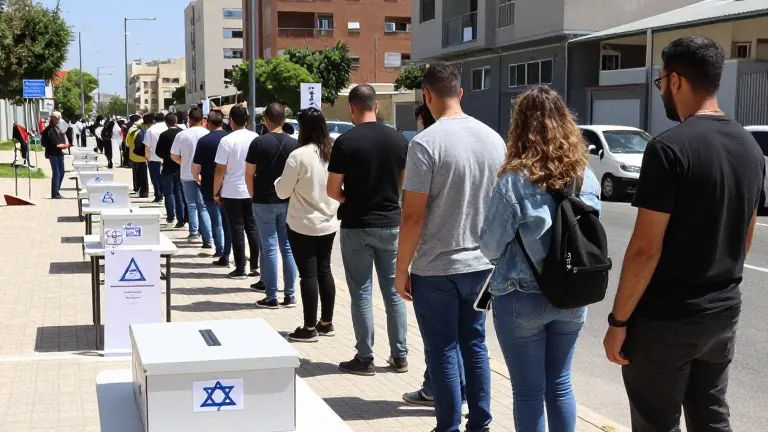
Prime Minister Benjamin Netanyahu avoided immediate defeat in Wednesday's election, but the record turnout of nearly 78% of eligible voters left the country without a clear path to a stable government. The high participation rate, the highest since 1999, reflects deep frustration with the current administration and anxiety over the ongoing conflict.
With 77% of votes counted, Netanyahu’s Likud party holds 20.8% of the total, while his main challenger, Gadi Eisenkot, leads the centrist Yashar party with 16.4%. These figures do not yet translate into specific seat counts in the 120-member Knesset. Likud’s share is down from 23.4% in the 2022 election, indicating a loss of support despite remaining the largest party.
Netanyahu has positioned his campaign to maintain his status as the longest-serving prime minister. He has rejected the idea of forming a government with Arab-led parties, a move he called treasonous. In remarks following the vote, he stated that Israel must establish a strong, right-wing, nationalist government and avoid relying on anti-Zionist Arab parties.
Eisenkot, a former military chief, has indicated he is open to partnering with Arab parties under specific conditions. These conditions include their recognition of Israel as a Jewish state and their designation of Hamas as an extremist group. However, several of Eisenkot's likely partners have previously ruled out such an alliance, creating uncertainty about whether they will change their stance to remove Netanyahu from office.
Arab-led parties achieved a historic showing in this election. Their constituents make up 20% of Israel's population. The United Arab List, the only Arab party to have joined a governing coalition in 2021, saw its headquarters filled with supporters. Party leader Mansour Abbas declared that the party is no longer on the sidelines.
The potential inclusion of Arab parties has sparked a national debate over identity. Some voters view the alliance as a necessary step to form a viable government, while others see it as a shift toward a rightward political stance. Hanna Doukhan, a voter in Tel Aviv, stated that she does not see a possibility to form a government without the Arabs. Conversely, Michal Shiloh in Jerusalem expressed a preference for a government without Arab parties.
The election results also reflect anger over military draft exemptions for the ultra-Orthodox Jewish population. Opponents of the current government argue that Netanyahu allowed these exemptions to remain in place while others served in the war. Eisenkot's likely partners have vowed to conscript ultra-Orthodox men and bolster the independence of the judiciary if they form a coalition.
Far-right National Security Minister Itamar Ben-Gvir suffered a setback in the vote. Many Israelis viewed him as representing the most extreme elements of the current government. His performance suggests the governing coalition may have shrunk, though Likud remains best placed to be tasked with forming the next government by President Isaac Herzog. Herzog is not required to choose the leader of the largest party.
Final results are expected in the coming days after the counting of hundreds of thousands of absentee ballots from military personnel and diplomats. If no candidate can assemble a majority coalition, new elections could be held early next year. Israel experienced a similar stalemate between April 2019 and November 2022, resulting in five elections during that period.
Source: WDIV ClickOnDetroit